5 min
UWB on-demand ping: centimetre precision without the battery cost
Continuous UWB drains batteries. Ubudu's on-demand ping wakes a tag's Ultra-Wideband radio only when a precise fix is needed, so high-value assets get centimetre accuracy while the rest of the fleet sips power.
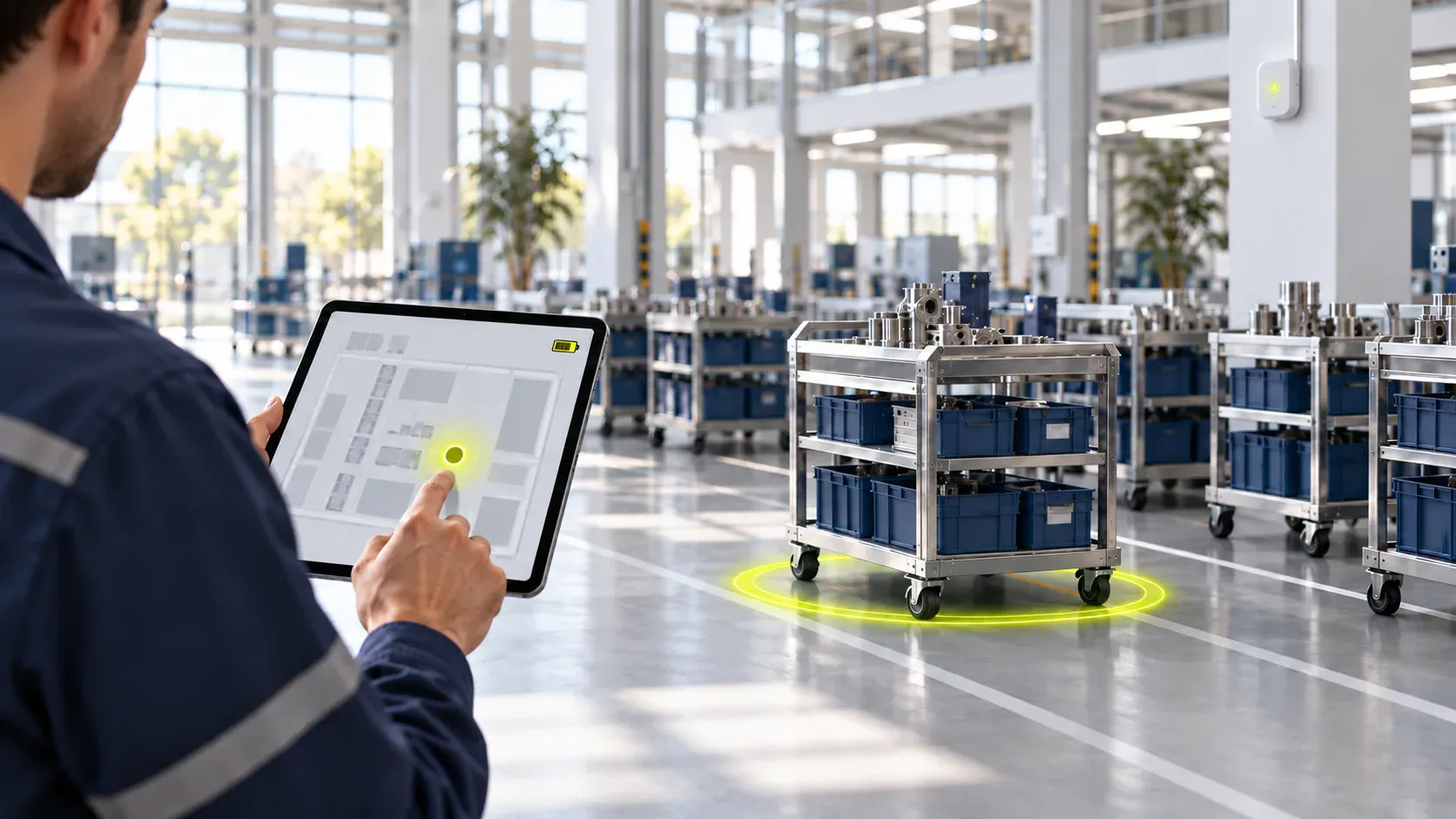
Ultra-Wideband gives you centimetre precision. Run it on every tag, all the time, and you pay for that accuracy in flat batteries and a congested radio, for precision most of your assets don’t need most of the time. Ubudu’s tags ping UWB on demand: centimetre accuracy exactly where and when it matters, and years of battery everywhere else.
Why precision everywhere is the wrong default
Ultra-Wideband is the most accurate radio in mainstream RTLS. It locates a tag to under 50 cm in a busy industrial environment, and under 20 cm in controlled conditions, close enough to tell which of two machines a trolley is parked at, or which bin holds a part. That precision is genuinely useful. It is also genuinely expensive to run.
The cost is not the hardware; it is keeping the radio awake. A tag that pings UWB continuously burns through battery far faster than a Bluetooth Low Energy one, so a pure-UWB fleet ends up tied to a charging routine or bulky batteries. Every tag that pings is also talking on the same air: put thousands of them on one site, all broadcasting constantly, and the UWB channel fills up. The usual answer is to add more anchors to keep pace, more hardware, more cabling, more to maintain.
And here is the part worth sitting with: most assets, most of the time, do not need centimetre accuracy. You need to know which zone a trolley is in, not its exact spot to the centimetre. Paying for precision on every tag, every second, buys accuracy you are not using, at the price of the battery life and the infrastructure you actually care about.
Precision on demand, not by default
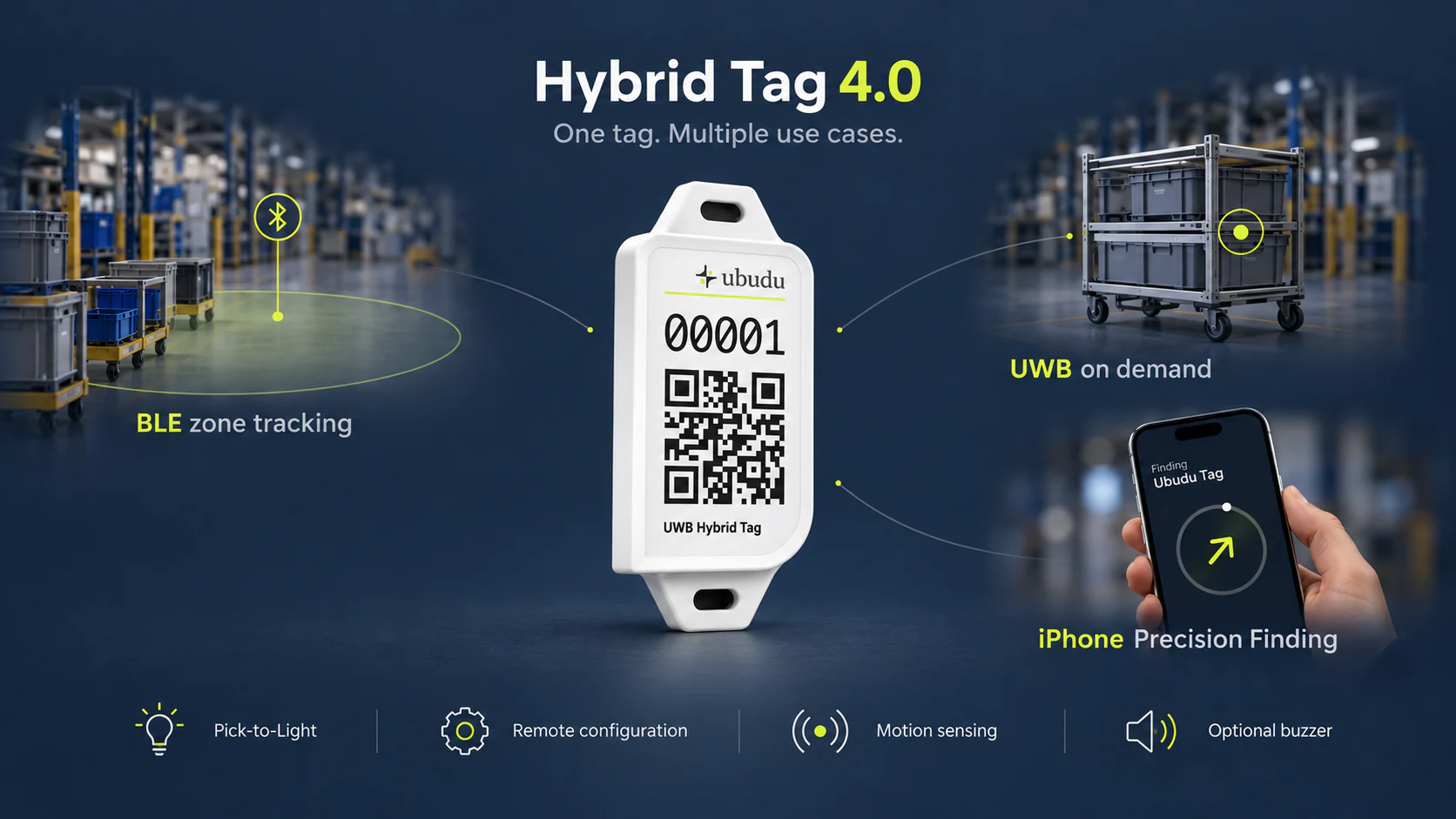
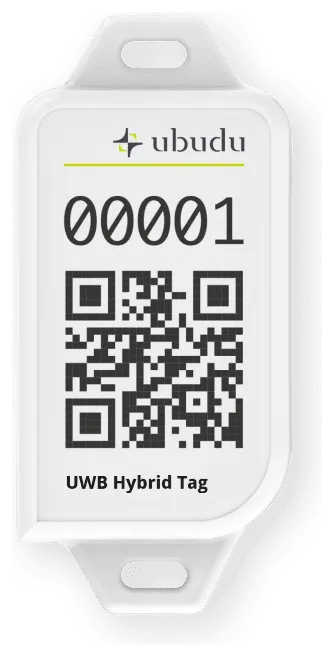
Ubudu takes the opposite approach. Every tag runs on low-power BLE by default, reporting its zone on one live map at very low energy cost, the right mode for most assets most of the time. The Ultra-Wideband radio stays asleep until something asks for a precise fix. When that happens, the tag’s power-saving firmware wakes UWB, takes a position to the centimetre, and drops straight back to BLE. Three things can ask.
When you ask
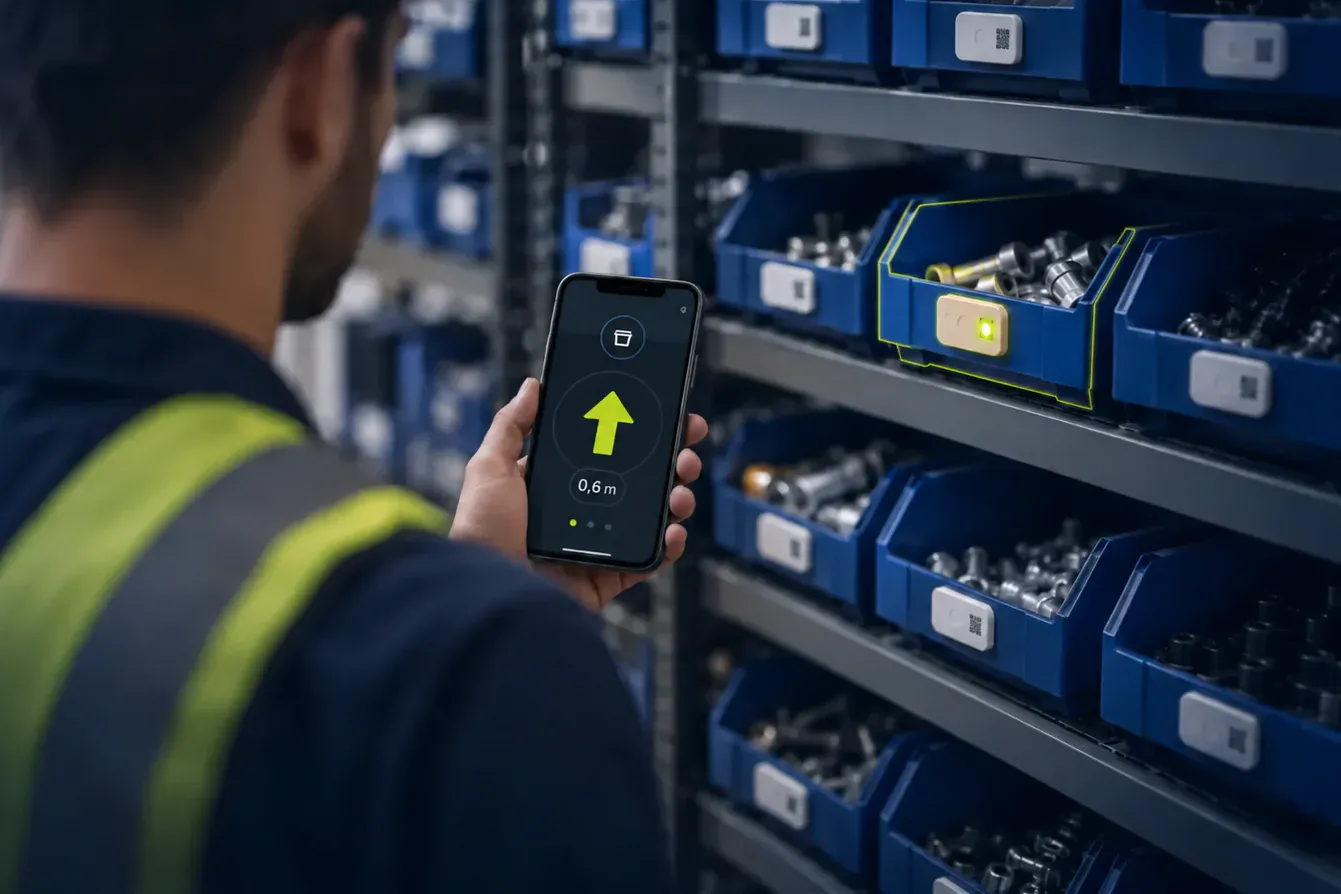
Someone runs a search for a specific asset, or starts a Precision Finding session to walk to it. The tag pings UWB and is located precisely; on a recent iPhone, the operator then follows an on-screen arrow and distance straight to it, down to around 10 cm. This is the on-the-spot lookup, where exactly is this, right now, and it is the moment precision earns its keep.
When it moves
The tag senses motion. An asset that has just been picked up, loaded or wheeled off is the one most likely to need an accurate fix, so movement itself can trigger a UWB ping. A tag sitting still stays quiet on BLE and sips power; a tag on the move reports precisely, then settles again.
When it enters a zone
Crossing into a defined area, a dispatch bay, a calibration room, a safety-critical zone, can trigger a precise fix on its own. You get centimetre positioning exactly in the places that warrant it, without anyone lifting a finger, and plain zone tracking everywhere else.
Centimetre precision is worth paying for exactly where and when you ask for it, and almost nowhere else.
What it means on the floor
On-demand ping changes the economics of a deployment. You tag everything once for low-cost, zone-level visibility, then let precision switch itself on per asset and per moment, a search, a movement, a border crossed. Batteries last years instead of needing a charging routine. The UWB channel stays clear because tags only speak when they have something precise to say, so the anchors you install go further and you buy fewer of them. And it is one device on one platform: the same hybrid UWB-and-BLE tag, on the same anchors, running on-premise or in Ubudu’s GDPR-compliant European cloud.
The pattern shows up across real deployments. At Queen Elizabeth Hospital in Hong Kong, staff locate stretchers faster when a bed is needed. Paris Saint-Joseph Hospital keeps track of more than 1,500 pieces of equipment. Schneider Electric’s SETBT plant runs live work-order visibility on the floor. In each case the value is not precision for its own sake, it is precision on the assets and at the moments that matter, paid for only there.
It is the hybrid approach Ubudu runs on more than 6,000 sites across 35+ countries: broad, low-cost coverage first, centimetre accuracy on demand where it earns its place.
In short
- Precision costs power: continuous UWB drains batteries and congests the radio; most assets only need zone-level tracking most of the time.
- UWB wakes on a trigger: a search or Precision Finding session, motion, or entering a defined zone; otherwise the tag stays on low-power BLE.
- Accuracy where it counts: under 50 cm in industrial conditions, under 20 cm in controlled ones, around 10 cm walking to it on an iPhone.
- Lower cost fleet-wide: years of battery, a clearer UWB channel and fewer anchors, on one tag and one platform.
More innovations