5 min
Meet the Spatial AI agents: location that reasons and acts
Spatial AI puts a layer of autonomous agents on top of your live RTLS data: you describe what you want in plain language, and they reason over the floor and act on it.

A live map is a satisfying thing to open. Every tagged asset, vehicle and person is there on the floor plan, moving in real time. But a map only pays off when someone acts on what it shows, and for most of the shift, nobody is watching it. The free forklift is somewhere on screen. So is the work order that has sat in packing for an hour. Seeing a problem and doing something about it are not the same thing.
Why a live map isn’t enough
For a decade, real-time location has answered one question well: where is everything, right now. That is genuinely useful, but it hands you raw positions and leaves the thinking to you. Operators do not want another screen to watch. They want an answer to the question already in their head, and they want the obvious follow-up to happen without them.
Spatial AI is Ubudu’s answer: a layer of agents that sit on top of your live location data, reason over it, and act. You configure them by describing what you want in plain language. Four agents make up the set, an assistant that answers questions, a rule agent that acts on events, a dashboard copilot that builds the view you describe, and a script agent that turns intent into automation, but two of them change the working day the most.
Ask the floor a question
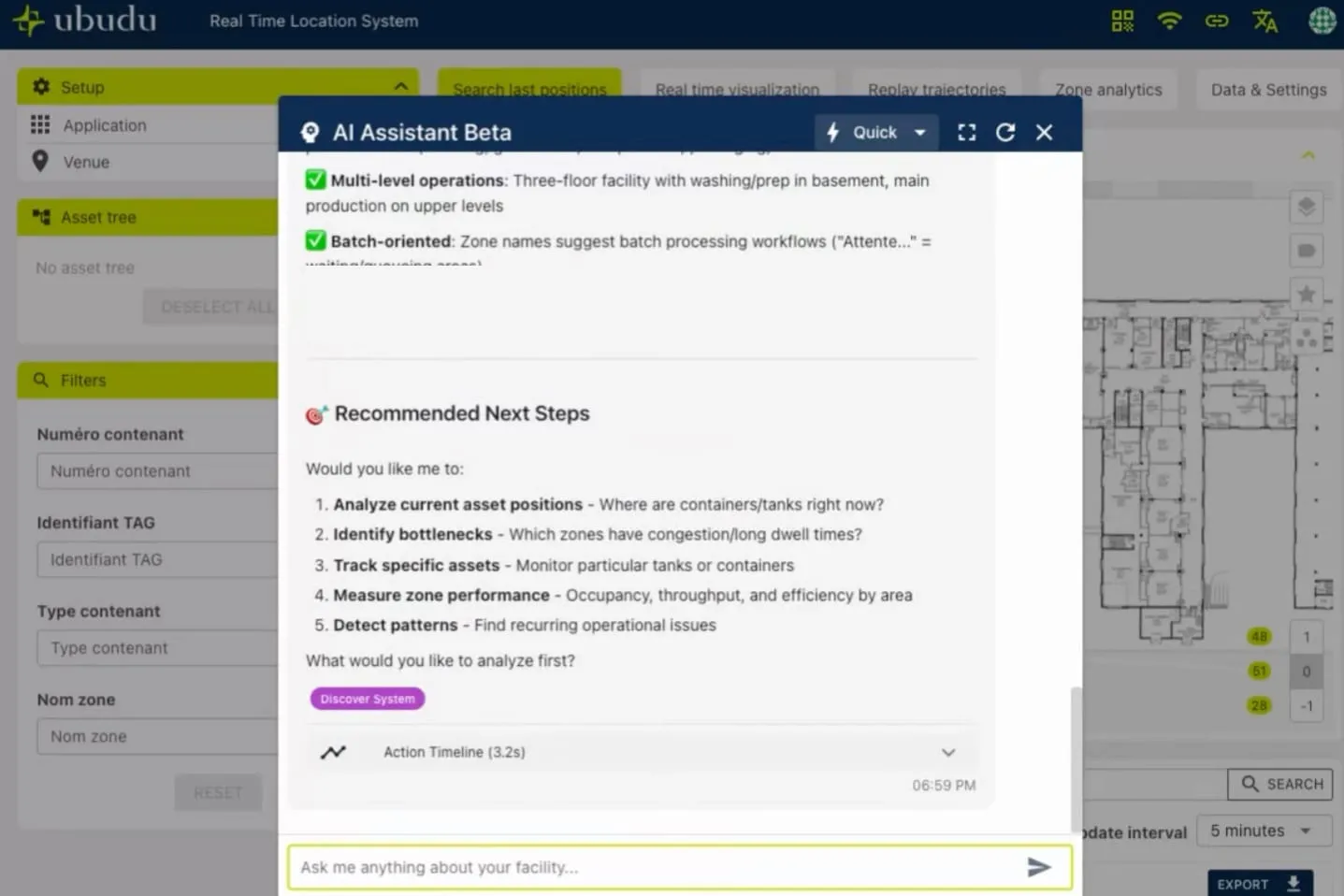
The RTLS AI Assistant lets anyone query the live floor in plain words. Where is the nearest free forklift? Which work orders have waited too long in packing? Show me every stretcher on the third floor. The answer is grounded in current positions, because the assistant reads the same live data the map is drawn from, not a cached report, and not a guess.
That is the difference between knowing the data is in there somewhere and getting it out in a sentence. At Schneider Electric’s SETBT site, teams already follow work orders live through production, so asking the floor a direct question is the natural next step. At Queen Elizabeth Hospital in Hong Kong, staff locate stretchers faster instead of walking the wards to find one.
Let rules act on location events
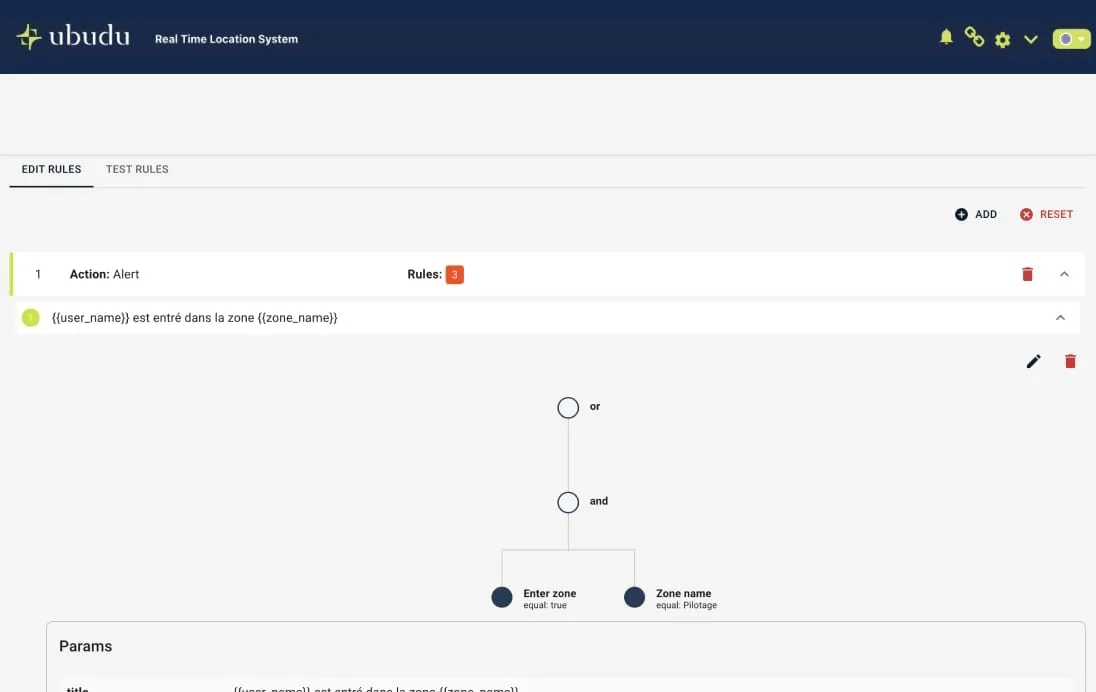
Answering is half of it. The Rule Agent handles the other half: describe in words what should happen when something enters a zone, leaves it, stalls or goes missing, and it builds the rule, tests it over your real location data, and runs it from then on.
When a rule fires, something happens in the physical world, not just a line in a log:
- Alerts: tell the right person the moment an asset leaves its zone or a queue backs up.
- Webhooks: push the event straight into your WMS, MES or ERP, so your own systems react.
- Pick-to-Light: blink the right tag so an operator walks straight to it.
Every action an agent takes is tracked and audited, so you can always see what fired and when.
Location stops being a screen you watch and becomes a question you can ask and an action that fires on its own.
Built on verified location
Agents are only as trustworthy as the positions they reason over. Ubudu’s engine fuses several positioning technologies on one platform, from BLE zoning to UWB that locates to under 50 cm in a busy industrial environment and under 20 cm in controlled conditions. It integrates over REST, WebSocket, MQTT and webhooks, and a dedicated MCP server lets the AI assistants query that live floor directly. It is load-tested to 3,000 tags, 6,000 anchors and 600 maps per engine, and runs on-premise or in Ubudu’s GDPR-compliant European cloud.
So when an agent answers a question or fires a rule, it is working from real positions on a deployment built to scale, not from a demo dataset.
What it means on the floor
The payoff shows up in the day, not the architecture diagram. Decisions get faster, because the answer is a sentence away instead of a hunt across a screen. Fewer events slip through, because a rule watches every zone at once and acts the instant something changes, including on the night shift when no one is at the desk. And people spend less time staring at a map: the floor tells them when it needs them, rather than asking them to stand guard over it.
This is the same platform where Paris Saint-Joseph Hospital locates more than 1,500 pieces of equipment, running on more than 6,000 deployments across 35+ countries. Start by seeing the floor, then let it answer, and let it act.
In short
- Ask in plain language: query live positions in a sentence and get an answer grounded in the current floor.
- Let rules act: describe a rule once; it fires alerts, webhooks and Pick-to-Light on its own.
- Grounded, not guessing: agents reason over verified, real-time position, and every action is audited.
- Built to scale: one engine, open APIs and an MCP server, on-premise or in the GDPR-compliant European cloud.
More innovations